
Washington Township Directory Collections
No single database gathers every year of Washington Township directories online. No verified local publisher or year run exists to point to either. That gap matters more than it sounds. A name match from one modern search may come from the wrong volume entirely. Treat each historical directory as a dated source. Before relying on a listing, ask the holding library which edition it came from, what area the volume covered, and whether it included an address-first section.
| Collections | Years | Where Held | Access |
|---|---|---|---|
| Centerville and Washington Township directory materials | Exact runs not verified | Washington-Centerville Public Library, Centerville and Woodbourne | Ask staff to confirm the edition, shelf record, and any local or suburban coverage. |
| Dayton, Montgomery County, and Miami Valley local-history material | More than 200 years of regional material | Dayton Room, Dayton Metro Library Main Library | Local-history staff, in-library resources, microfilm scanners, and appointments as needed. |
| Criss-cross, reverse, and telephone directories | Exact holdings not verified | WCPL or Dayton Room, subject to staff confirmation | Request a specific estimated year, street address, and community label. |
| County historical people and property records | Ranges vary by record class | Montgomery County Records Center & Archives | Staff retrieval in the research area, not open shelf browsing. |
Write down the edition year and page before drawing any conclusion. A printed listing ties a name to an address only as of the compilation date. That date matters. It cannot prove present residence or legal ownership. Nor did every adult in a household make it into the volume.
Washington Township Historic Directory Labels
Try more than one place label first. Historical material may sit under Washington Township, Centerville, a Dayton postal address, or Woodbourne. A postal city is not a government boundary. Publishers often chose the community name their readers knew best. Keep the wording exactly as printed rather than converting it to a modern address format.
The Centerville-Washington History Woodbourne exhibit adds useful context for this part of a resident lookup. Woodbourne was registered in 1817 after early settlement and platting. Its village grew along a Main Street. That street lay near the Great Miami River and the Whipp area. The industrial village faded by about 1860. Later subdivision development followed.
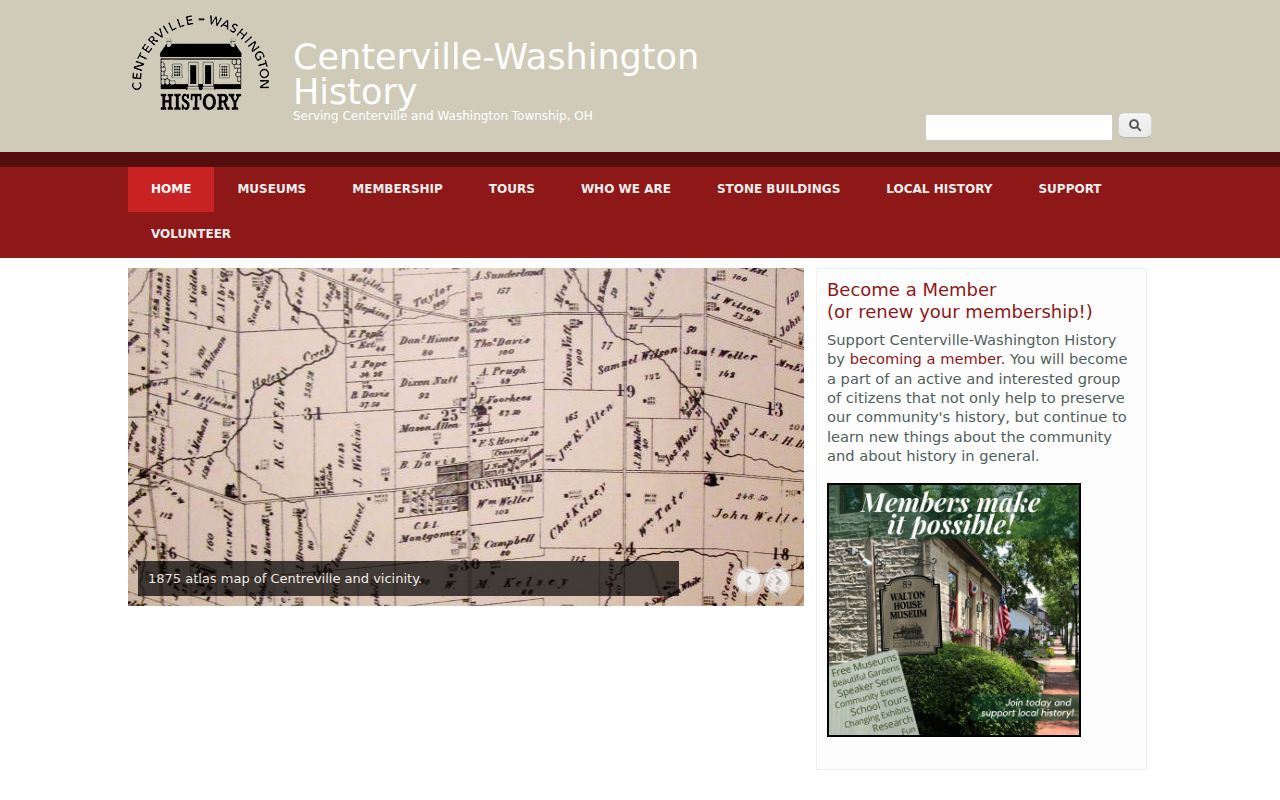
A Woodbourne reference can still be geographically relevant. It matters even when a newer record says Centerville or Dayton. Pair the original place name with a street, lot, township-section-range description, or nearby road when searching catalogues and indexes.
Dayton Room Directory Research
The Dayton Room at Dayton Metro Library is the clearest documented local starting point before an exact Washington Township directory shelf is confirmed. The collection spans more than 200 years. It covers Dayton, Montgomery County, and Miami Valley history in books, photographs, pamphlets, maps, manuscripts, newspapers, magazines, postcards, and video. Local-history and genealogy staff work there. So do computers and microfilm scanners. Together they make it a practical place to turn a name or address into a cited historical question.
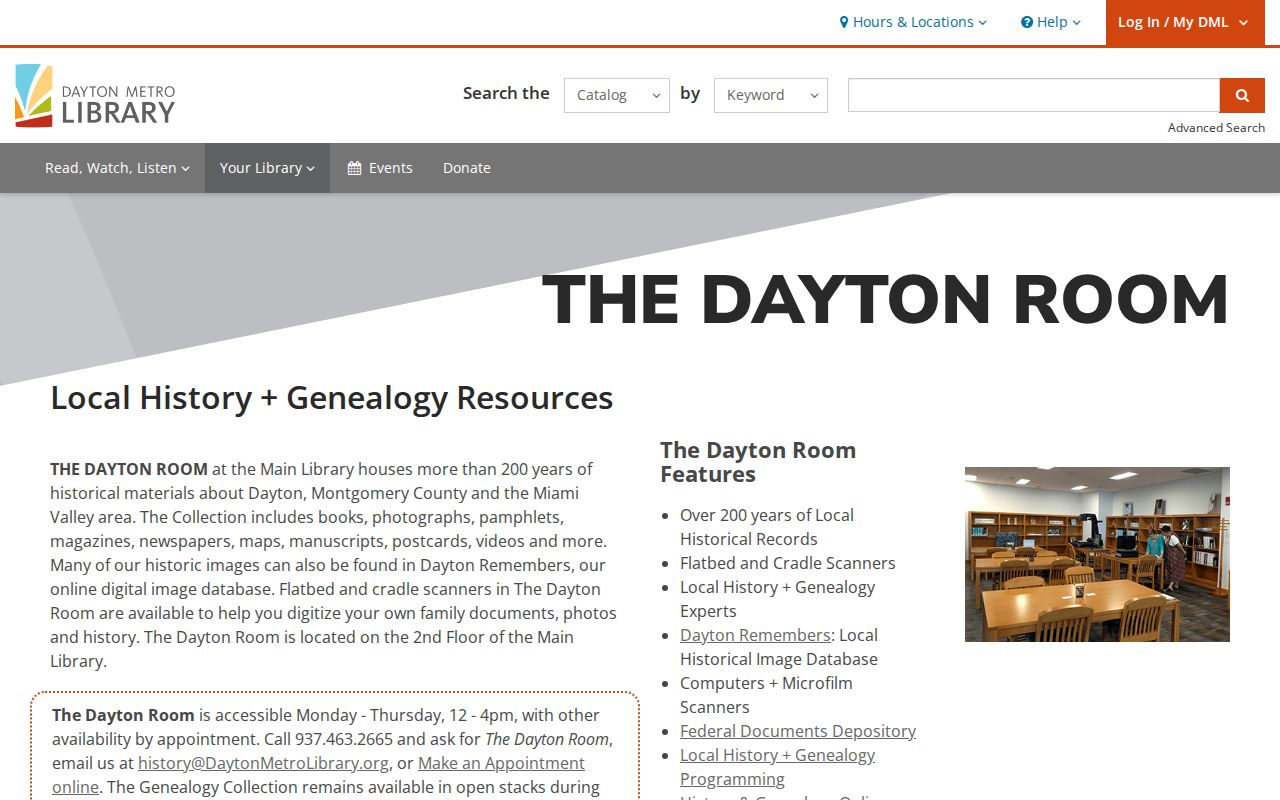
The Dayton Room sits on the second floor of the Main Library at 215 E. Third Street in Dayton. Listed hours run Monday through Thursday, noon to 4 p.m., with appointment options. Call 937-463-2665 or email history@daytonmetrolibrary.org. Documented resources include in-library Ancestry, Fold3, Dayton Remembers, the Dayton Obituary and Genealogy Database, and Dayton Daily News runs for 1898-1922 and 1990-present. These tools can test a directory finding. They cannot prove a directory run covers every year. Nor do they reach every Washington Township address.
Reading a Washington Township Directory
No scanned Washington Township or Centerville directory page appears in the library's online materials. No field labels or abbreviation keys are published there. The inventory here is a method for taking notes from an actual volume. It is not a reconstructed local entry. Copy exactly what the book prints. Include initials, punctuation, address form, section title, and edition year. When a mark looks important, photograph or transcribe the key before interpreting it.
| Edition and page | Capture the title, year, volume or call number, page or image, and institution holding it. |
|---|---|
| Printed name | Keep the spelling, initials, and surname order as shown; these details help separate people with similar names. |
| Address wording | Copy the street, community label, rural route, lot, or other form exactly as printed. |
| Other printed details | Note a spouse, occupation, business, or status mark only when that particular volume supplies it. |
| Section and key | Record whether the line came from an alphabetical, business, street-order, or other section, then preserve the volume's own key. |
- Criss-cross directory
- An address-first arrangement that may list names by street and number. Its use depends on the exact edition and geographic coverage.
- Householder index
- An index organized around the named household or address entry, if the volume provides one. It is not necessarily a complete list of all people at the address.
- Abbreviation key
- The publisher's explanation of shorthand, usually near the front or back of a volume. Read it before giving a mark a meaning.
Asking for Washington Township Directories
Washington-Centerville Public Library serves Centerville and Washington Township through its Centerville and Woodbourne locations. Its official pages confirm local research help. They also confirm FamilySearch Affiliate Library access, but not an exact city-directory series, publisher, date range, or reverse-directory run. So make the request precise. Give a surname with its variants. Give an approximate date, the address exactly as written, and every possible place label. Ask staff to check Centerville, Washington Township, Dayton suburban, telephone, criss-cross, reverse-directory, yearbook, newspaper, and microfilm holdings.
Careful wording avoids a familiar dead end. A library can hold a volume catalogued under Centerville, Dayton, Montgomery County, or another directory type, yet a broad question about a Washington Township historical directory never surfaces it. Reach the Centerville desk at 937-433-8091 or the Woodbourne desk at 937-435-3700. Staff can then say whether a source sits on site, exists digitally, lives on microfilm, or requires a scheduled research session.
Note. Do not call an unverified local volume a Haines directory or claim it has a reverse section until staff confirms the publisher, edition, and coverage.
Washington Township Directory Timelines
Think of the local record trail as period-specific sources rather than one continuous directory sequence. Montgomery County and Washington Township were both established in 1803. Centerville grew from an early nineteenth-century settlement. It incorporated as a town in 1830 and became a city in 1968. Those shifts explain a familiar puzzle. One family or property can appear under a township, town, city, village, road community, or postal label. The right label depends on the year.
- 1803-1850: begin with Records Center marriages, deeds, wills, estates, maps, and FamilySearch naturalization leads. A modern street number may not exist.
- 1850-1908: pair census research with county tax duplicates, deed indexes, historic birth and death books, Dayton Room newspapers, and maps.
- 1909-1959: use a confirmed directory edition with tax, marriage, divorce, and newspaper evidence. A name match still needs a date and a place check.
- 1960 onward: use county property and recorded-document systems for dated official evidence, then request Township material for a particular permit or case when appropriate.
Treat this as a research timeline rather than proof that a directory exists for every period. It points to the companion record most likely to bridge a missing edition or an unfamiliar old address form.
Washington Township Directory Family History
Good family-history work follows one person or household across dated records instead of reading a single directory line as a full biography. Begin with the earliest confirmed spelling and place label. From there, move forward and backward through the volumes staff have identified as relevant. A change in street, spouse notation, occupation, or community label is a prompt. It signals a need for an independent dated record, not proof on its own.
- Locate a confirmed directory edition and copy its title, year, page, name, and address wording.
- Search the same name and reasonable spelling variants in the closest available edition on either side.
- If the volume has a confirmed criss-cross section, check the address there and preserve the section title and page.
- Pair the directory date with a released federal census and compare household composition, age, and locality without assuming the names are automatically the same people.
- Use a dated newspaper, obituary, cemetery record, deed, or estate file to explain a move, death, or ownership change.
A name vanishing from a directory can mean many things: a move, a death, non-listing, a changed address form, or simply an edition that never covered the place. The right next step is comparing the publication date against the census, property, and newspaper trail rather than supplying a reason the source itself never states.
Washington Township Directory Archive Leads
Some questions outgrow a library shelf. Montgomery County Records Center & Archives holds an indexed system covering more than 47,000 record locations and can retrieve historical family and property material. It is not a circulating or browseable collection. A useful request names the person, record class, date range, and place context, then asks to inspect or copy the identified material in the research area.
The Records Center is at 117 S. Main Street on the sixth floor of the Reibold Building in Dayton, with a weekday research room schedule of 8 a.m. to 5 p.m. and a listed number of 937-225-6366. Its historical collections can supply a dated marriage, estate, deed, tax, election, naturalization, or court lead that helps evaluate a directory entry. Keep the archival reference separate from the directory citation, because the two sources describe different things.
Washington Township Directory Limits
A directory proves only what a publisher printed on one date. It can omit people entirely. The canvass may predate publication. The address convention may look unfamiliar. The street may sit under a different community label. Never treat an entry as proof of present residence or ownership. Keep the full citation. Keep the source date, the printed role, and every uncertainty in your notes. For a modern parcel question, rely on dated county property and recorded-document evidence. Don't stretch an old directory past its purpose. The Washington Township street records guide walks through that current address-to-parcel route. Old directories earn their keep when read beside the actual edition. Read them beside a census, a deed or tax record, and local newspaper or archival context.